OpenMerch SDK
Editor refactor program · branch feat/openmerch-sdk · last
update
2026-07-14, Gate-2 truth verdicts are in — sweatshirt passes on
placement truth (authored twin now governs the sold route), hoodie
fails honestly (the IR bridge cannot represent its construction
yet)
Phases
0 · Git hygiene + branch outdone
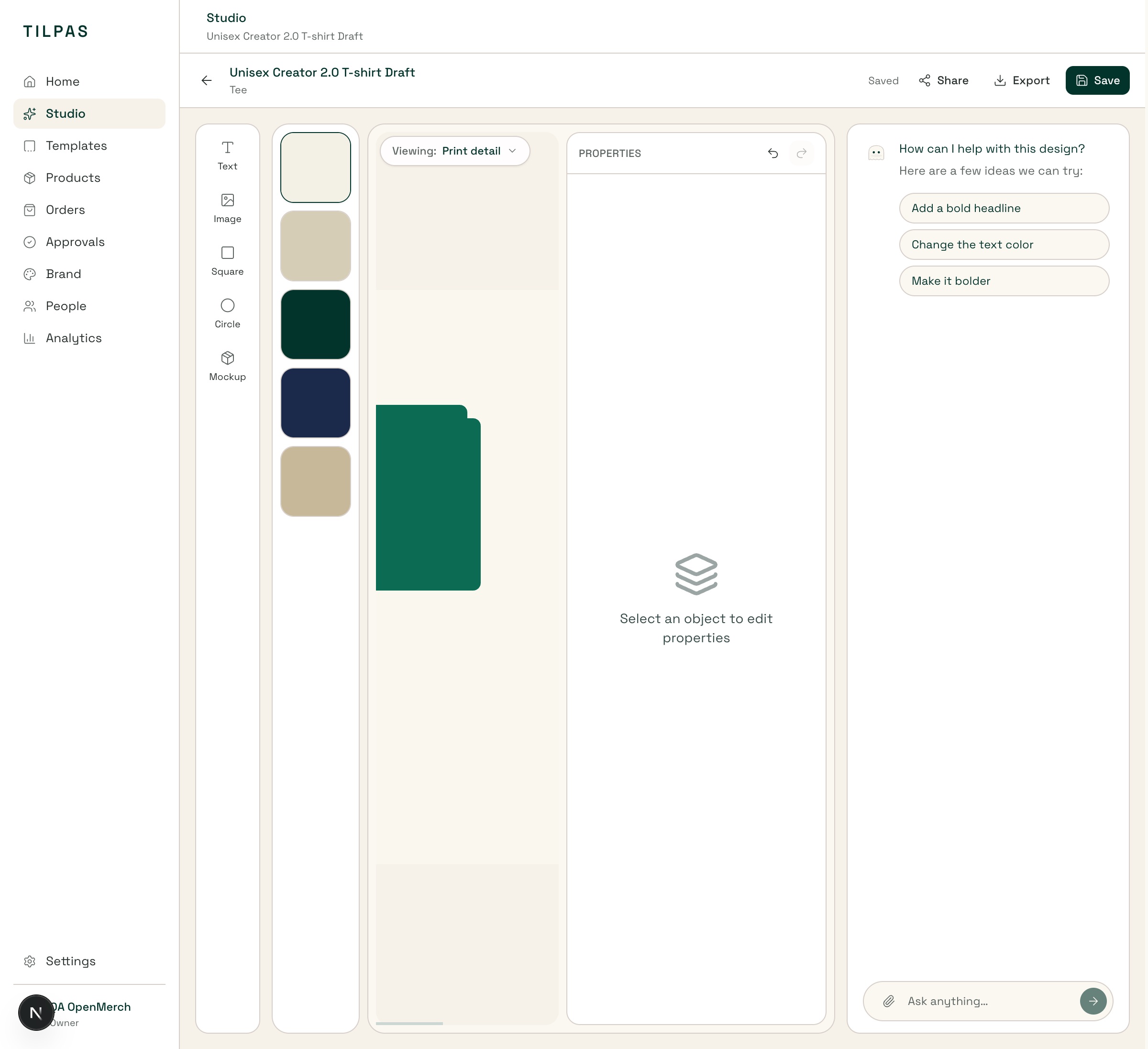
1 · Baseline visual QA + feature matrix (3 surfaces)done
2 · SDK architecture spec + adversarial reviewdone
3 · Scaffold @openmerch/* + headless coredone
4 · Port studio surfacedone
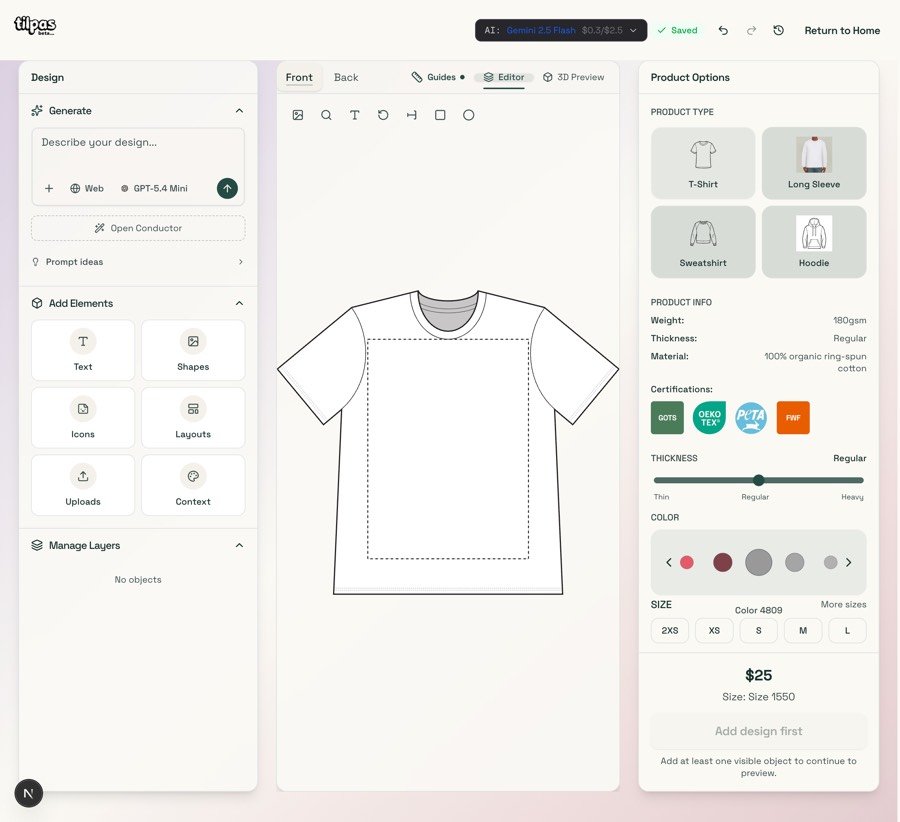
5 · Port /design + delete Yjs/collab stackdone
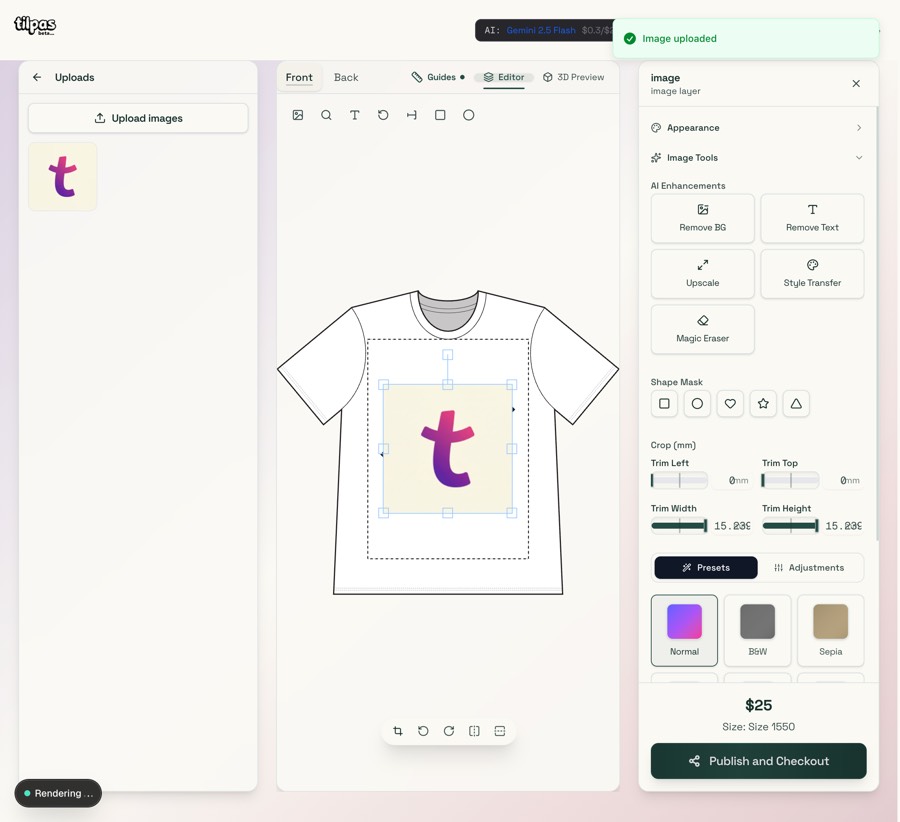
6 · Port /customize buyer surfacedone
7 · Legacy sweep of next-appdone
8 · Final QA: golden E2E + visual diff + docsdone
9 · Extract @openmerch/garment-3d (WebGPU twin)done
10 · Direct-on-garment mm editingdone
11 · Print-process realismdone
12 · Hoodie + sweatshirt truth lanes → Gate-2 verdictdone
Decisions
-
SDK = OpenMerch (
@openmerch/*), building
on the existing types package. Tilpas stays the consumer brand.
-
Multiplayer dies. Yjs/CRDT and the worker-editor
collab path get deleted outright. The core stays event-sourced so
collab can come back as a plugin without rearchitecting.
-
Gate 2 golden E2E stays green at every commit; the Sep 30 funnel
outranks architectural purity.
-
garment-ir is the neutral POD contract, Printify is one adapter.
Printify-derived GLB/mockup assets flagged as likely non-sublicensable
before any external deal.
-
Provider seams (AI tools, storage, fonts) + white-label theming built
in from day one.
Updates
2026-07-14 · Gate-2 verdicts: sweatshirt PASS on placement truth,
hoodie FAIL with measured evidence — both beads closed
The sweatshirt lane closed as a pass. The compiled twin (regraded
pattern, seam deltas at 0.0 mm, six decoration zones, distortion
under the cap) was promoted to an authored-pattern canonical donor,
and the family's placement truth now points at it on all 54 routes —
including the sold blueprint 95 / provider 30 route. Print
rects are derived from the compiled panel map by a new deterministic
exporter, so front, back and both sleeves carry
production-calibrated UV rects instead of display-shell guesses.
Provider-expanded neck areas fail closed with explicit blockers, and
nothing in checkout or fabrication consumes the flip. Display is
untouched: the founder's bar ("the fixed shell must not look worse
than the original") holds, the twin's drape is still draft (detached
neckband ring, recorded in its realism gate), so every surface keeps
the b49 shell — zero model URLs changed. Both adversarial reviews
passed after the derived JSONs were regenerated in a clean worktree
so no parallel drift rode along.
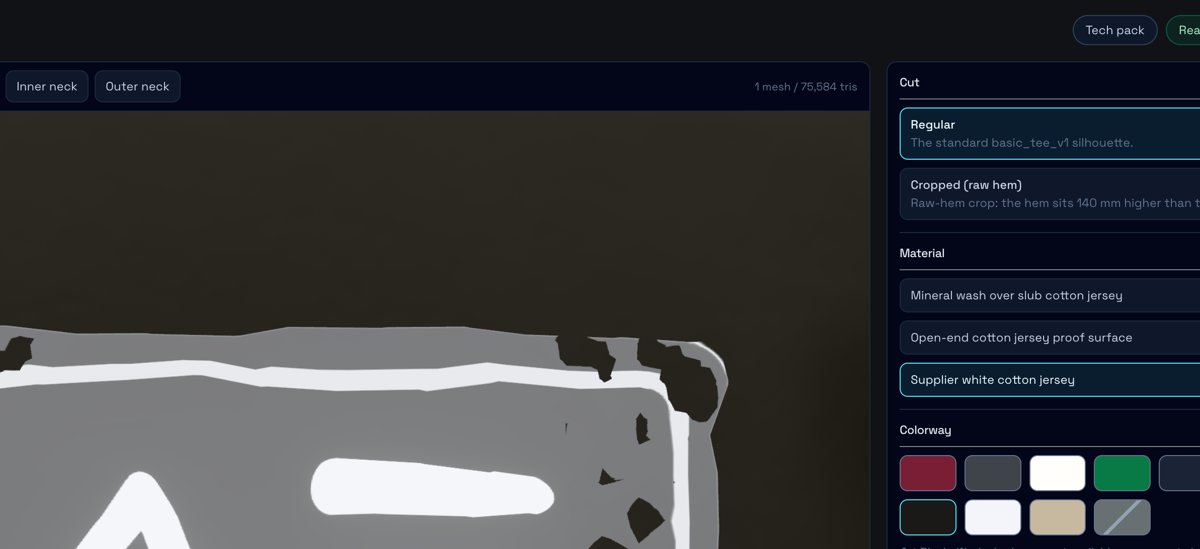
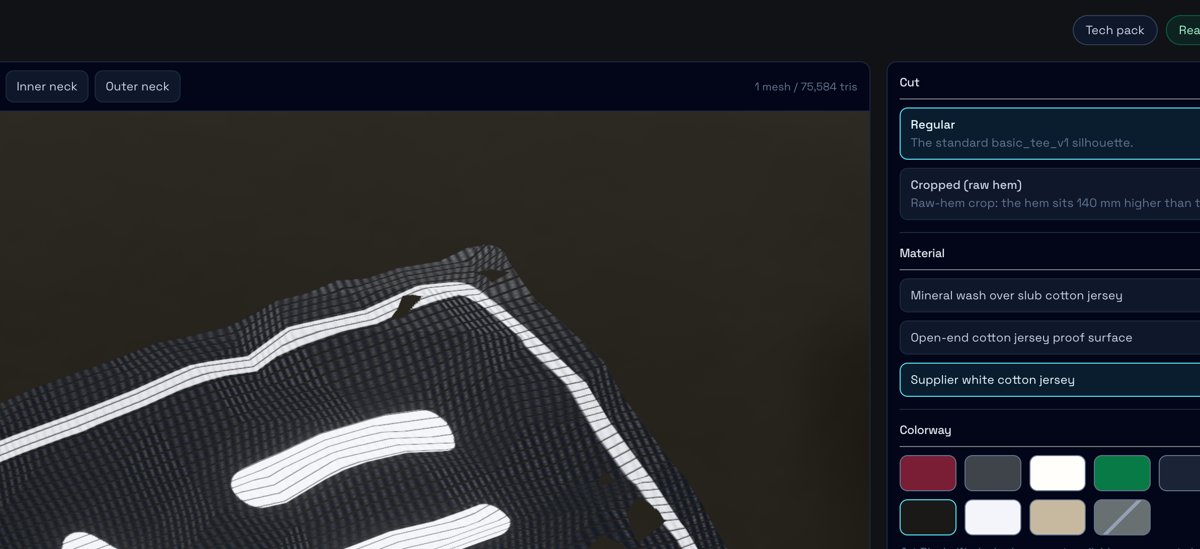
The hoodie lane closed as an honest fail. The IR bridge resolves
seam sides by edge id alone, so the pocket's partial-edge attachment
collapses into a full hem seam; the fixture's cuff and waistband
joins are tube self-closures the bridge also cannot express. That is
a cannot-represent verdict, measured and independently verified —
not a quality judgment call. Per the freeze rule the hoodie ships
the existing UV-transfer preview lane and placeholder card, and
partial-edge seam support in the bridge is the named reopening
criterion. Donor gating was hardened so no tee donor can silently
stand in for a hoodie again.
2026-07-11 · Print realism ships — nine technique/colorway cells
inspected shot-by-shot, preview and commit agree to the pixel
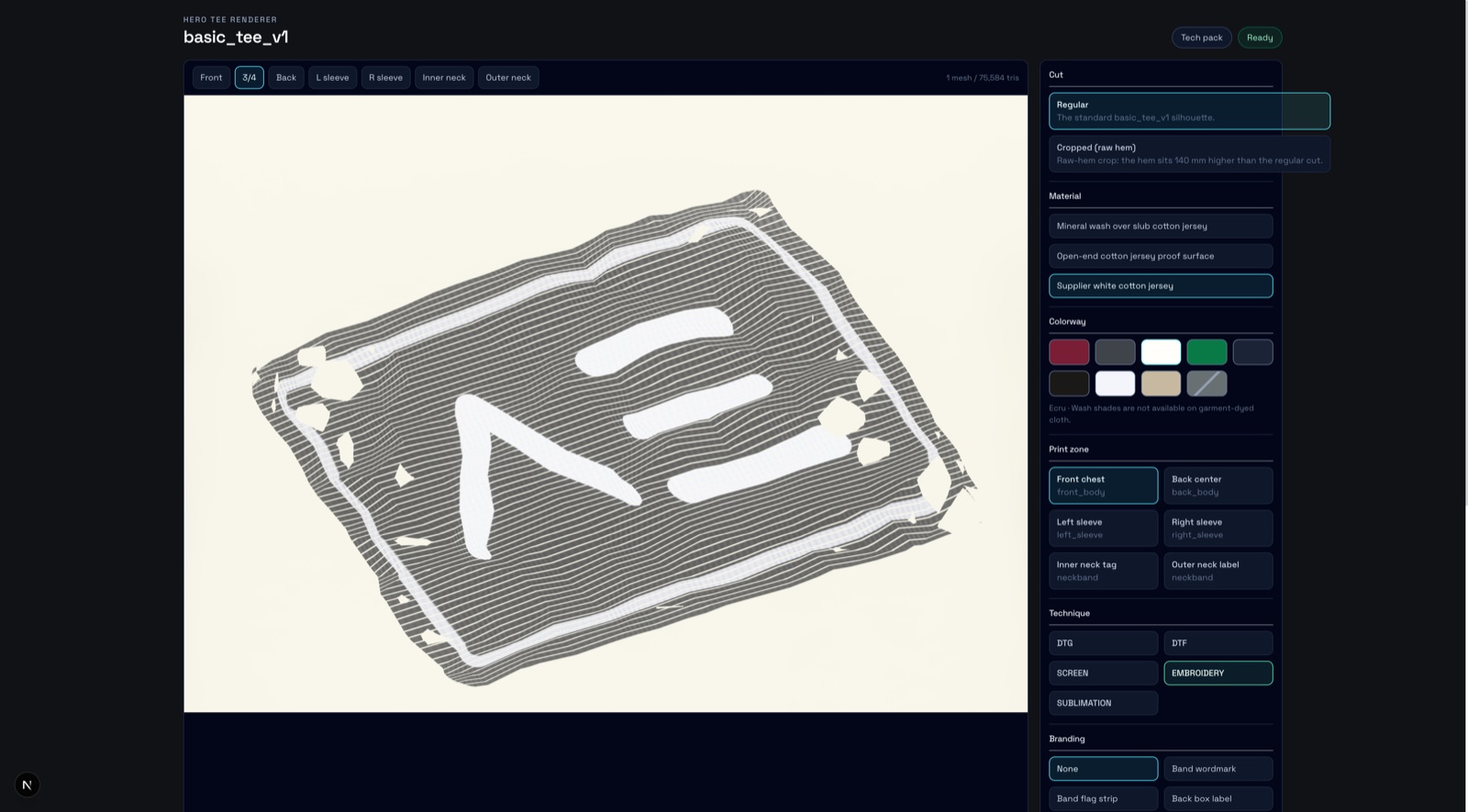
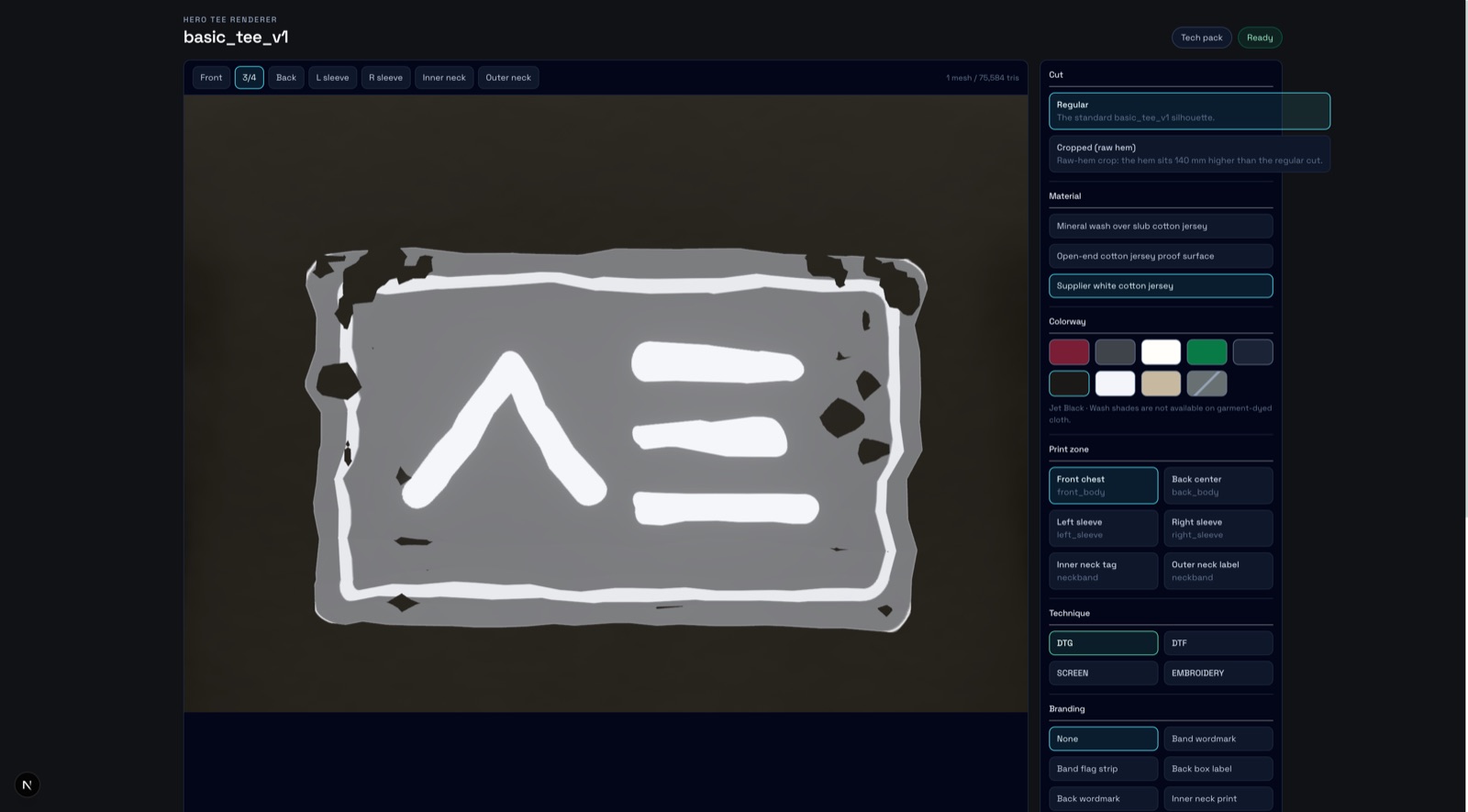
The print-process realism phase is done. The closing QA pass rendered
the same artwork through every technique the editor offers — DTG,
screen print, DTF transfer, embroidery on both ecru and jet black,
plus sublimation — and every frame was inspected by eye against the
failure list that matters in production: prints that float off the
cloth like stickers, plastisol that lets the weave show through, white
ink missing under a print on black, embroidery without the directional
sheen real thread has, dye that changes the fabric's surface. None of
it happened. DTG on black shows its white underbase; the screen layer
hides the weave exactly as an opaque film should; DTF reads glossier
and sharper than DTG with its carrier film visible; embroidery keeps
its thread-direction highlight even rotated 30°; sublimation dyes the
cloth without touching its relief. A second probe held a live drag
mid-gesture and compared it against the committed result: the only
pixels that changed were the measurement HUD and the selection guides
— the garment itself is identical, so what you see while dragging is
exactly what you get. Interaction stays fast: 95th-percentile frame
cost during a drag is 1.1 ms against the 4 ms budget. Full gate suite
green: golden E2E 5/5, 155 material tests, all typechecks and
boundaries clean.
2026-07-11 · Fabric materials tell the truth now — measured sidecar v2,
renders pixel-verified unchanged
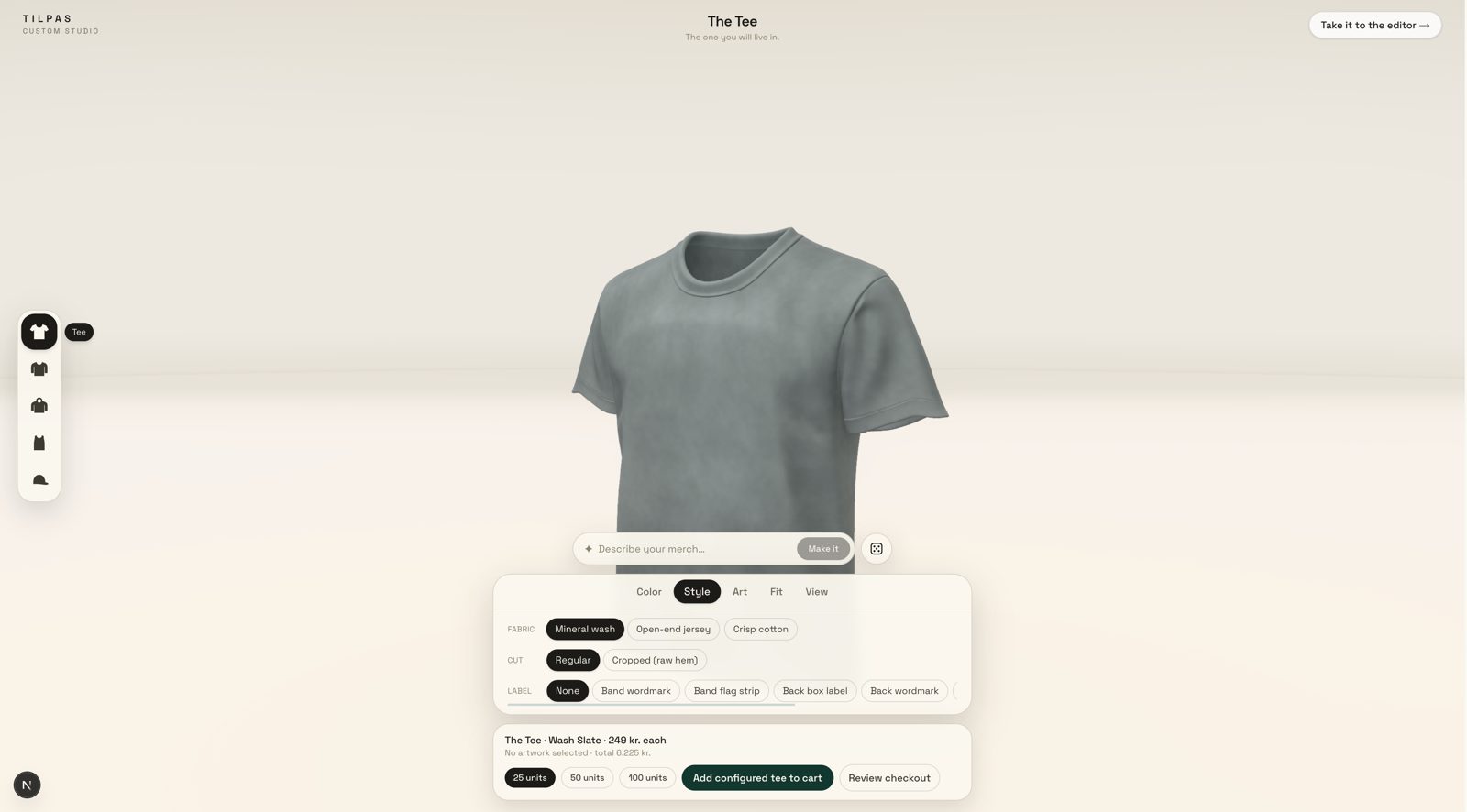
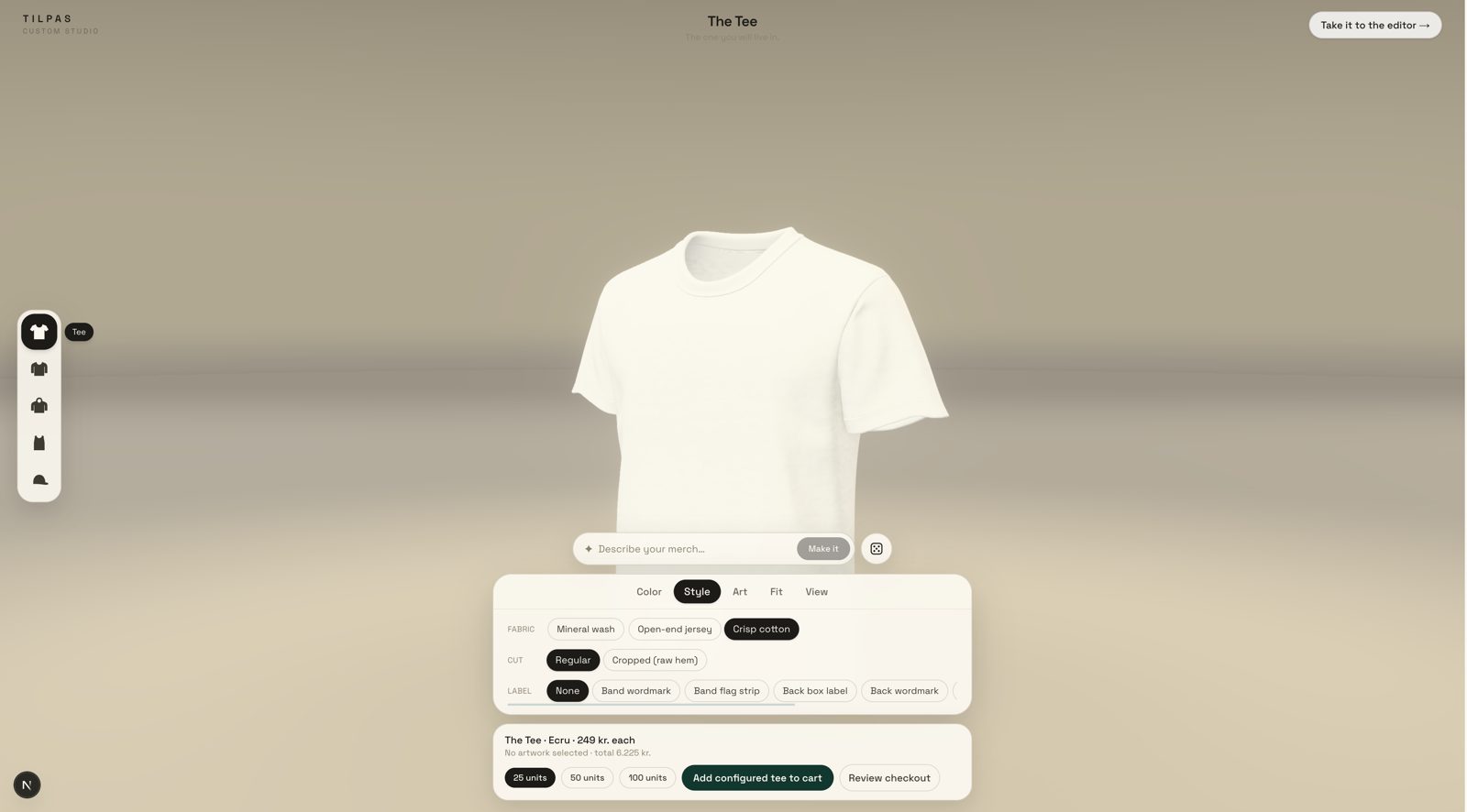
Step 5 of print realism is in. Every fabric the renderer ships (hero
tee, mineral wash, open-end jersey, supplier white) now carries an
honest machine-readable description of itself: where its capture came
from, what conventions its maps use, the physical size of one pattern
repeat, how its surface must be mapped, and whether the display uses
the captured maps or the renderer's procedural cloth. All the old
guesswork died — the unit-guessing tiling heuristic, the
"if the name contains patina" sniff, and two hardcoded material-id
escape hatches. The review round caught something subtle: the spec's
single "surface strategy" field couldn't describe reality, because
texture choice and surface mapping turned out to be independent — all
four combinations exist in shipped fabrics. Collapsing them would have
silently swapped one fabric's captured textures for procedural ones,
so the schema got two honest fields instead, and the tech-pack sheet
that production partners see now labels a tile size "(nominal)" until
a real measured swatch backs it. The whole point was changing nothing
visually: the two fabrics that carried the riskiest rewiring came back
bit-identical in before/after captures, the other two differ only at
invisible micro-grain level, and the full gate suite (155 material
tests, golden E2E 5/5) stayed green.
2026-07-11 · Print technique is now a saved design choice — picker in
the dock, persisted through undo, reload and export
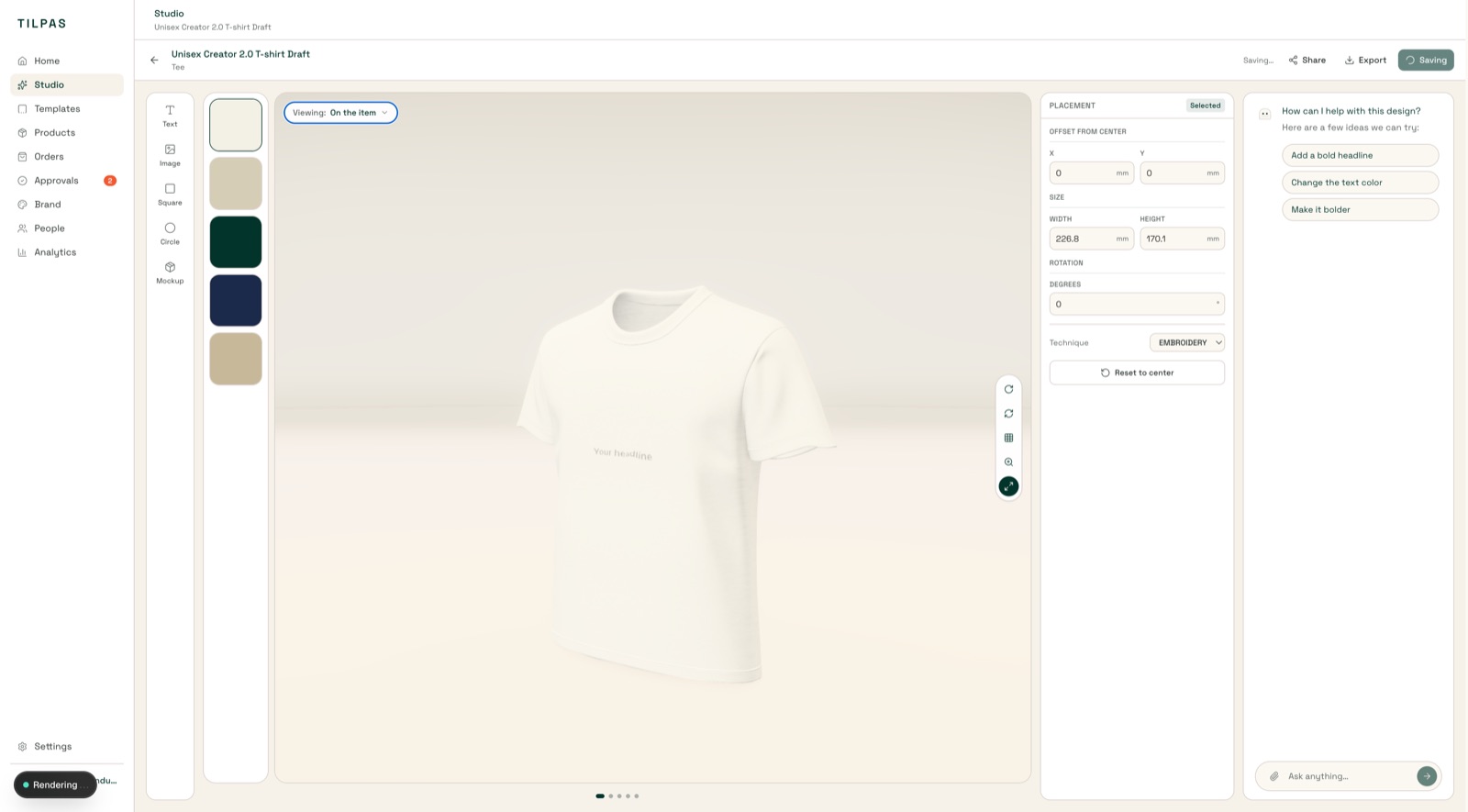
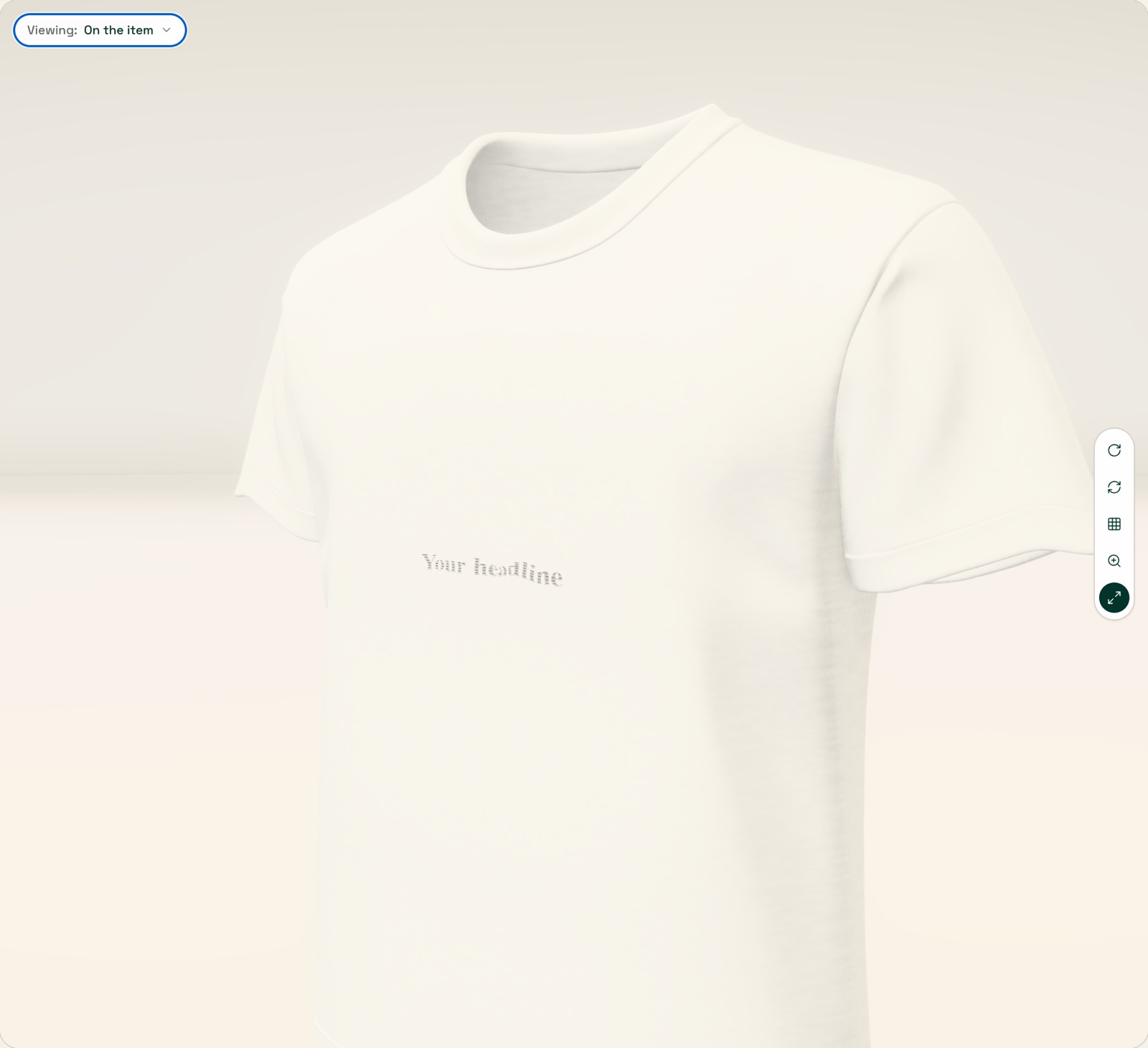
Step 4 of print realism is live. The technique a design is meant for
(DTG, DTF, embroidery) is no longer just a render setting — it lives in
the design document itself. The placement dock grew a technique picker
that only offers what the garment zone and colorway physically allow;
picking embroidery re-renders the print as stitches on the spot, marks
the document dirty, saves, and survives reload, undo and redo like any
other placement edit. If a saved choice later becomes unavailable (say
the colorway flips dark and excludes sublimation) the document keeps
the user's intent untouched and the UI shows the resolved fallback
with a note — nothing is silently rewritten. Export now downloads a
versioned .composition.json alongside the PNG carrying
the mm placement frame, technique and print-rect — the manufacturing
contract, no renderer internals. The document format bumped to v3 with
a hard rule for the future: a document written by a newer app version
shows "needs a newer app version" and disables saving everywhere
(including the proof route), and the save path is now a single locked
transaction so a stale open tab can never overwrite newer work. Two
adversarial reviews drove eight fixes before commit — among them that
save race, a proof loader that quietly degraded instead of failing,
and a render-path crash for documents carrying a technique the zone
never declared. Gates: 513 core tests, full golden E2E 5/5 (the
placement gate now also proves picker persistence and both export
downloads), and live visual QA on the twin.
2026-07-11 · Physically honest ink rendering shipped — every technique
looks like its process
Step 3 of print realism is live. Committed prints now render through a
real ink model instead of a flat decal: linear-light compositing with a
white underbase on dark garments (visible as a physically plausible
halo on jet black), per-technique film coverage and roughness,
embroidery as analytic 0.4mm stitch rows whose thread direction and
specular follow the artwork rotation, and weave that continues under
thin ink instead of stopping at the print edge. A 36-shot evidence
matrix (5 techniques × light/dark × 4 camera angles) was captured
through the production preview page and inspected shot by shot — zero
blocking defects; measured pixels match the spec equations by hand.
The heavier material compile exposed a hidden timing assumption in the
placement E2E gate (it probed before the twin was drag-ready and the
camera orbited away) — the gate now waits on the viewer's real ready
signal, and the full golden suite is 5/5 again. The tank's
receiver-overlay art path was restored and smoke-verified live.
2026-07-11 · Print realism under way — spec binding, color + technique
contract landed
The print-process realism spec survived two adversarial reviews plus an
independent verification pass and is now binding
(docs/specs/openmerch-print-process-realism.md). Steps 1–2
of six are shipped. Color foundation: OKLCH utilities with branded
encoded/linear types, the faithful Khronos PBR Neutral curve with
an analytic inverse, and one shared lightness source — the renderer,
colorways, and stage selection all classify dark/light garments through
the same OKLCH-L thresholds now (the old loader disagreed with the app
about forest and wash-slate). A live emissive color-checker probe
renders 16 swatches through the real WebGPU pipeline and round-trips
within deltaE 0.0014 (gate: 0.02). Technique contract v2: every
print technique (DTG, screen/plastisol, DTF, embroidery, sublimation)
is a measured, provenance-commented variant — cured film height in mm,
weave show-through, ink roughness, edge profile, underbase behavior —
and a shared resolver picks legal techniques per zone with real
garment-darkness context (sublimation is excluded on darks). A
characterization test pins the render output byte-identical until the
step-3 ink core swaps in; a Proxy-based consumption test proves no
contract field is decorative. Step 3 (the physically honest ink render
path: linear underbase compositing, physical stitch pitch, embroidery
anisotropy with a real thread-direction field, weave continuity across
the print edge) is implementing now.
2026-07-11 · Direct-on-garment mm editing shipped — placement gate
green
All seven steps landed. Users drag, resize, and rotate the committed
print directly on the 3D garment with a live mm HUD; the HUD, the
WebGPU decal, and the manufacturing export all derive from one
panel-space mm frame (derivePanelSpaceExportFrame +
compileAreaPlacement), so what you place is what gets
printed — parity is asserted by unit fixtures at 0°/30°/90° and
non-uniform scales, and out-of-raster placements are refused before
Canvas can silently crop. Committed decals now project with true
rotation (the old axis-aligned bounds projection stretched rotated
art). QA evidence: a new golden gate
(openmerch-placement-parity.test.ts) drags on the twin,
reads the dock mm, saves, reloads, and requires exact restore; the
placement-preview benchmark holds p95 0.5ms / max 0.6ms across 120
frames (4ms budget). The pass also root-caused the flaky Gate 1: the
save indicator's exit animation kept the stale "Saved" label visible
for ~200ms after an edit, so the E2E's text poll reloaded before the
debounced autosave fired and the back-area edit was lost. Save gating
now asserts the raw machine via data-save-status — Gate 1
went 5/5 after three consecutive suite failures before the fix.
2026-07-10 · @openmerch/garment-3d extracted — all surfaces QA green
The ~18k-LOC WebGPU garment twin now lives in
@openmerch/garment-3d: viewer, loader, surface picker
(panel-space mm), print-surface contracts, technique appearance, and
the product-neutral color pipeline. The licensing boundary holds —
Printify-derived data (asset URLs, receiver-surface registry, print
areas, fabric textures) stays in next-app and is injected through four
required loader dependencies on the viewer; a boundary scan in the
package typecheck keeps it that way.
packages/next-app/src/components/3d/webgpu is deleted and
all consumers (/customize, /garment-preview, /design-studio, studio
mockup scenes) import the package. Verified: package tests 52/52,
scoped app suites 36/36, typecheck + boundary scans clean, golden gates
4/4, and hands-on browser QA of all four surfaces with zero page
errors — including the authed studio in both 3D modes ("On the item"
and the "In use" live scene). Along the way the pre-push preflight got
a real fix: a lint chunk containing only biome-ignored markdown files
no longer aborts the push. Next: direct-on-garment mm editing on top
of the extracted surface picker.
2026-07-07 · Final QA done — golden gates green, program complete
Phase 8 shipped in five commits. 9e2baba368 finishes the
interrupted ColorField repair (hex input keeps a focused draft; 3-digit
shorthand expands only on blur/Enter — the studio baseline defect — with
7 regression tests). 742137992 lands the golden E2E merge
gates (save→reload parity across both print areas, publish gating, tee +
cap add-to-cart with metadata) and deletes the five Yjs-era Playwright
suites; 4/4 green on three consecutive runs.
4ea5f9f214 fixes three Major /customize baseline defects
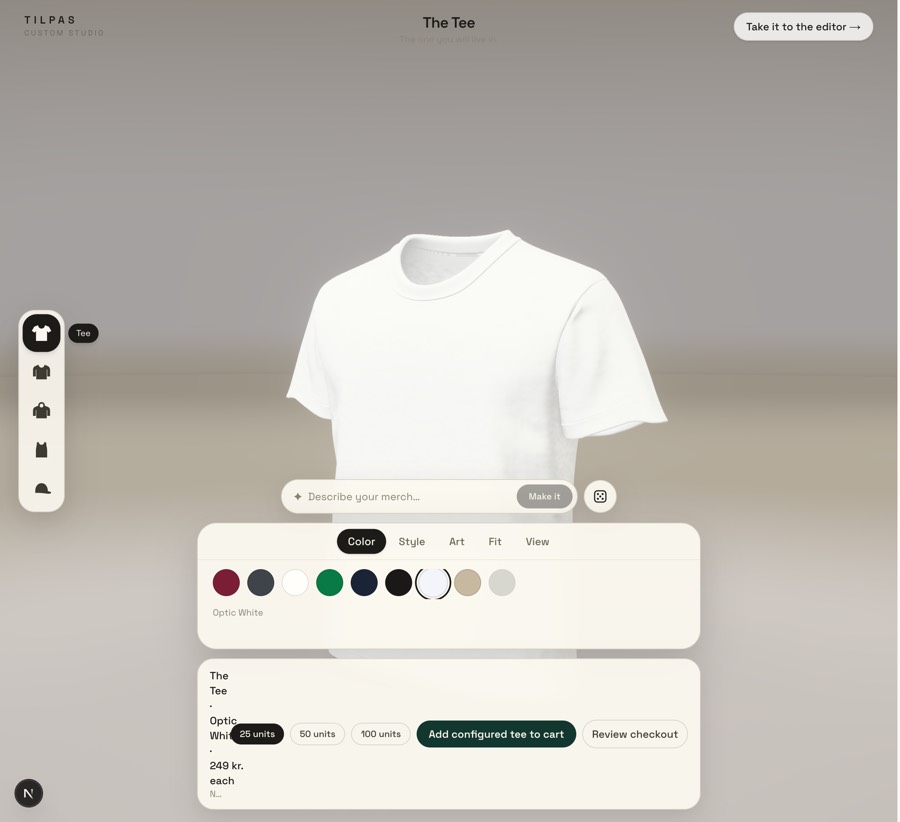
(hardcoded “tee” CTA, order-summary sliver, artwork/currency honesty on
the cart line). 7aaef82af2 fixes a live studio regression
the QA pass caught: fill edits updated the panel but never the canvas,
because the resolver didn't know EditorProvider-mounted engines —
@openmerch/react now exports
useOptionalEngine and the resolver checks it. Final-QA
evidence (30 shots + defect-disposition matrix vs the 2026-07-05
baseline) lives in
harness/evidence/openmerch-final-qa/REPORT.md; SDK docs
landed as README.md in @openmerch/core and @openmerch/react. Every
Major+ baseline defect in scope is fixed or architecturally eliminated;
open remainder is cosmetic polish + the env-lane studio org-drift.
2026-07-06 · Legacy sweep done — 30k lines of editor-era code deleted
Three commits: 28c4ecb892 rewires the bare
useCanvas hook through the canvas-service registry (it read
a provider no production surface mounts, so shadow/matting/style
controls silently no-oped — shadow toggle now verified live on /design);
d526f3c291 drops the dead segmentation hook and the
CanvasDO-era JWT draft scope; 74ada30b38 deletes 147
orphaned files (29.3k lines): old agent chat panels, fabric-canvas
services, mobile tree, template gallery, layers panels, 46
components/editor orphans, 27 ai-elements files, dead canvas hooks and
design config. The set was cross-verified by an independent import-graph
audit and a clean-config knip scan, and A/B-tested: the full vitest
suite is bit-identical with and without the deleted files (56
pre-existing environment failures, logged for final QA). All three
surfaces smoke clean. Deferred: ~160 unused files outside the editor
scope (landing pages, explore, ecom, social, dev tools) — dead but not
editor legacy; separate cleanup decision.
2026-07-06 · /customize runs on the SDK — all three surfaces ported
Commit 94a12d6f62. The buyer studio's workplane dropped its
bespoke snapshot-array undo/redo and now mounts a per-zone
CanvasService: object add/delete/duplicate, z-reorder, clear-all, and
history all go through the engine managers, with
history:update driving both the button state and the
debounced commit back to the garment (that last part covers
undo-to-empty, where no object events fire). The port surfaced two
engine-level findings. One in the app: fabric v6 IText measures ~2x too
wide before it's attached to a canvas, so computing a centered position
up front mis-placed text — placement now adds first, then centers. One
real bug in core: history restore passed a completion callback as
loadFromJSON's second argument, which fabric v6 treats as a
per-object reviver — the final render never ran, leaving the visible
canvas stale after every undo/redo (and permanently blank on
undo-to-empty). Completion is the returned promise; fixed at the source
with tests moved to the promise contract. Live QA on :3005, zero page
errors throughout: add text/shape, ink recolor, font swap, duplicate,
reorder, delete, clear-all, undo/redo round-trips (both workplane and
garment texture), Front↔Back zone switching with design restore, and the
Done handoff — the Art panel picks up the studio artwork with placement
controls live.
2026-07-06 · the Yjs/collab stack is gone
Commit cb30fe6eb2 deletes multiplayer end to end. next-app
lost src/sync (orchestrator, yjs adapter, awareness,
predictive sync, telemetry), the collaboration components/hooks, the
proof-snapshot JWT plumbing, the /api/canvasdo routes, and
the whole orchestrator/awareness/collaborator slice of the editor store
— undo/redo and the history timeline now run purely on the SDK
CanvasService registry. shared dropped its yjs mapping modules. In
worker-editor the 1,800-line CanvasDOYjs durable object is deleted; the
MCP session/actions API it secretly hosted was re-homed verbatim into a
dedicated McpSessionStore DO (wrangler migration
v8-mcp-session-store), and jwt-auth lost its proof-scope
and DO-name path sniffing. yjs, y-protocols,
y-websocket, and lib0 are out of every
package.json. Verified live: worker boots, MCP session
create→action→readback round-trips on :5173, /design renders and edits
with zero console errors on :3005. next-app + shared + worker typechecks
clean; 155/155 worker tests and 25/25 touched next-app tests green,
including new McpSessionStore coverage.
2026-07-06 · studio runs on the SDK, live-verified
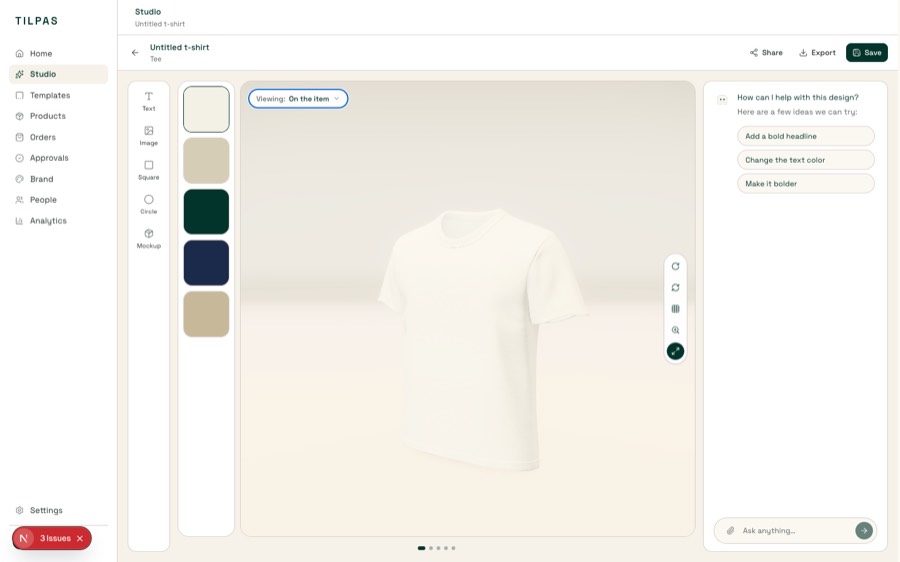
The studio surface is the first consumer of the full SDK stack:
@openmerch/react is real (EditorProvider + hooks, its own
boundary rules and tests), and studio's save path now flows through the
DocumentController — DesignDocument in/out, a rolling
design_versions row per draft, thumbnails to Cloudflare
Images, old payload shapes folded forward on read with their writer
deleted. Live parity gate caught two real engine bugs before sign-off:
the mount baseline marked every freshly opened document dirty (phantom
autosave on open), and undo was off-by-one — the first click restored
the state you were already in. Both fixed at the source: history is now
an explicit checkpoint model where mount re-baselines and a lone
baseline is not undoable. Verified in the browser: open→idle,
edit→Unsaved changes→Saving…→Saved, reload persists the design with
undo/redo correctly disabled, single-click undo/redo round-trips. 497
core + 3 react tests green.
2026-07-06 · the engine lives in the SDK now
The whole canvas engine — Fabric object model, CanvasService with all
its managers, event bridge, snapshot/export, guides — moved out of the
app into @openmerch/core. ~40k lines, originals deleted,
168 app files rewritten to import the SDK, Tilpas-branded engine names
neutralized. The engine's last app couplings (zustand stores, the dead
multiplayer seam, a server action) were severed first in a separate
surgical pass. Verified end to end: core's boundary check + 483 unit
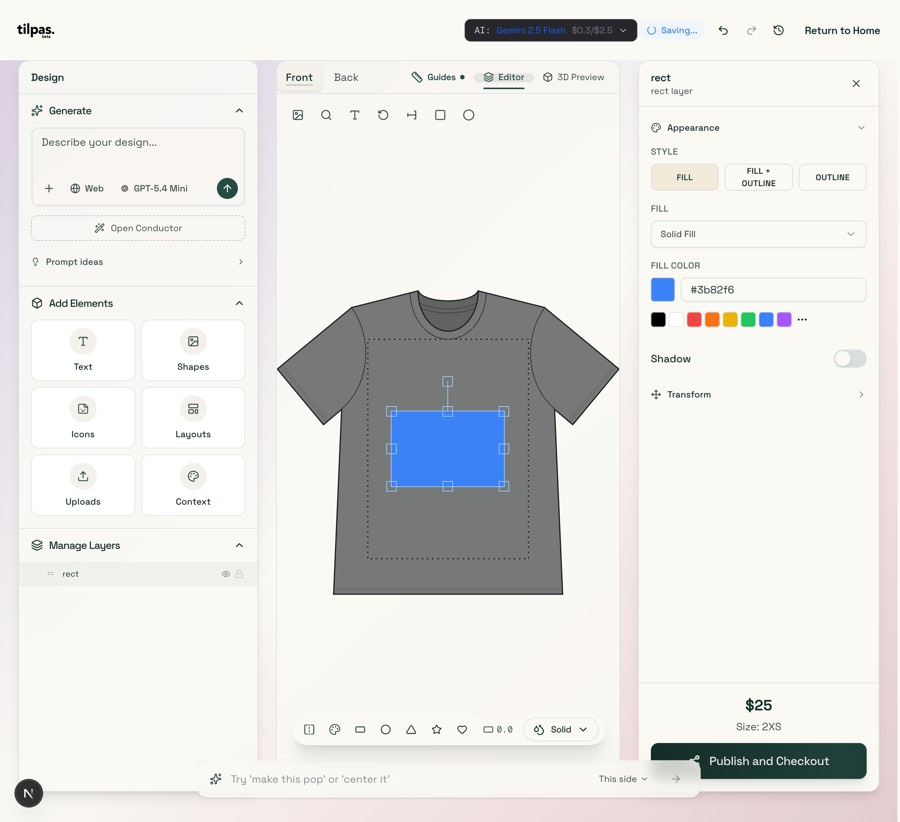
tests green, app typecheck green, and a live browser run — editor boots,
draft creates, a rectangle lands on the canvas and in the layer list
with zero page errors (screenshot below). Test debt went down, not up:
26 previously-failing fabric tests now pass under core's test setup.
2026-07-06 · @openmerch/core is real
First SDK code landed. @openmerch/core now holds the
versioned document schema (one document owning N print-area subtrees),
the save-state machine where "Saved" can only ever mean an acknowledged
write (unit-tested), typed redacted error envelopes, and all five
provider seams: persistence, asset storage, AI image ops, fonts, POD.
Import boundaries are enforced in CI from the first commit — core
physically cannot import React, Next, or app code. garment-ir is renamed
to @openmerch/garment-ir. Now extracting the ~40k-line
canvas engine out of the app: a surgical pass is severing its store/sync
couplings in place, then the wholesale move into core.
2026-07-06 · spec reviewed and hardened, scaffolding starts
Adversarial review done: an independent gpt-5.5 pass produced 20
evidence-backed findings; all folded into the spec. Biggest upgrades: a
save-state machine where "Saved" only ever means an acknowledged write,
versioned document schema with migrations, full undo/history semantics
(batching, branch-aware, selection excluded), typed + redacted error
envelopes on every provider seam, and a hard ordering rule — the SDK
save path must prove save→reload parity before Yjs gets deleted. Now
scaffolding @openmerch/* and the headless core.
2026-07-06 · baseline QA complete, big catch on /design
All three surfaces baselined with reports + ~70 screenshots (committed +
pushed). Headline finds:
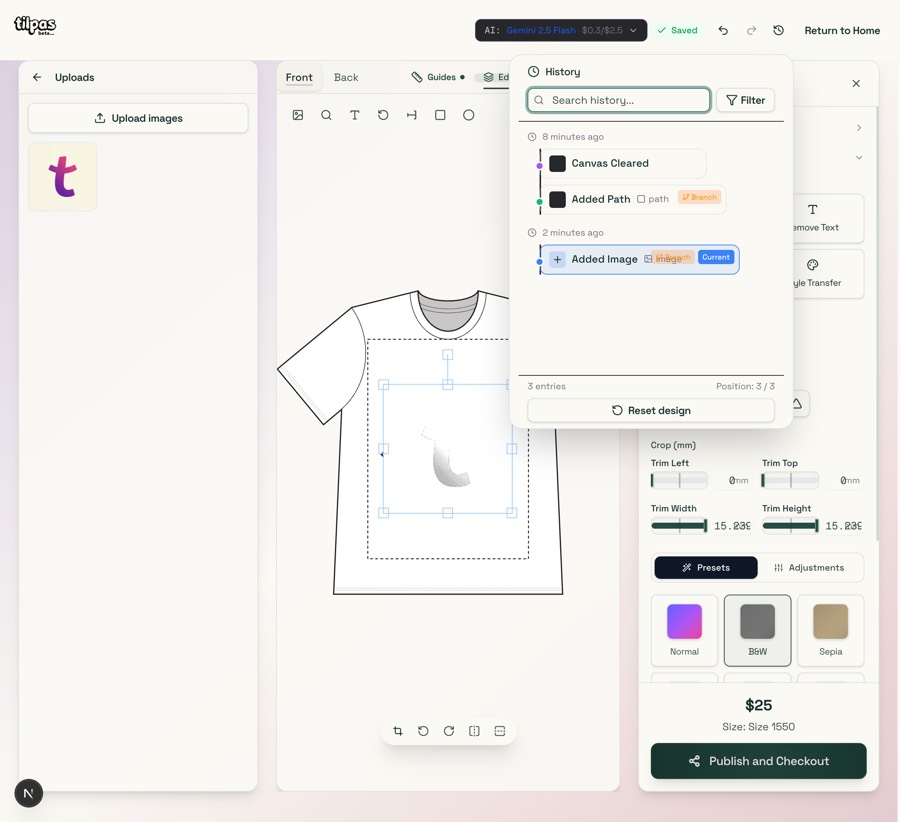
/design autosave is silently broken — saves ride the
Yjs websocket, the client falls back to an anonymous token before the
user session hydrates, and the worker rejects every connection; the UI
shows "Saving…" forever and a reload loses your edits. Strongest
possible validation of the "delete Yjs, save through an explicit
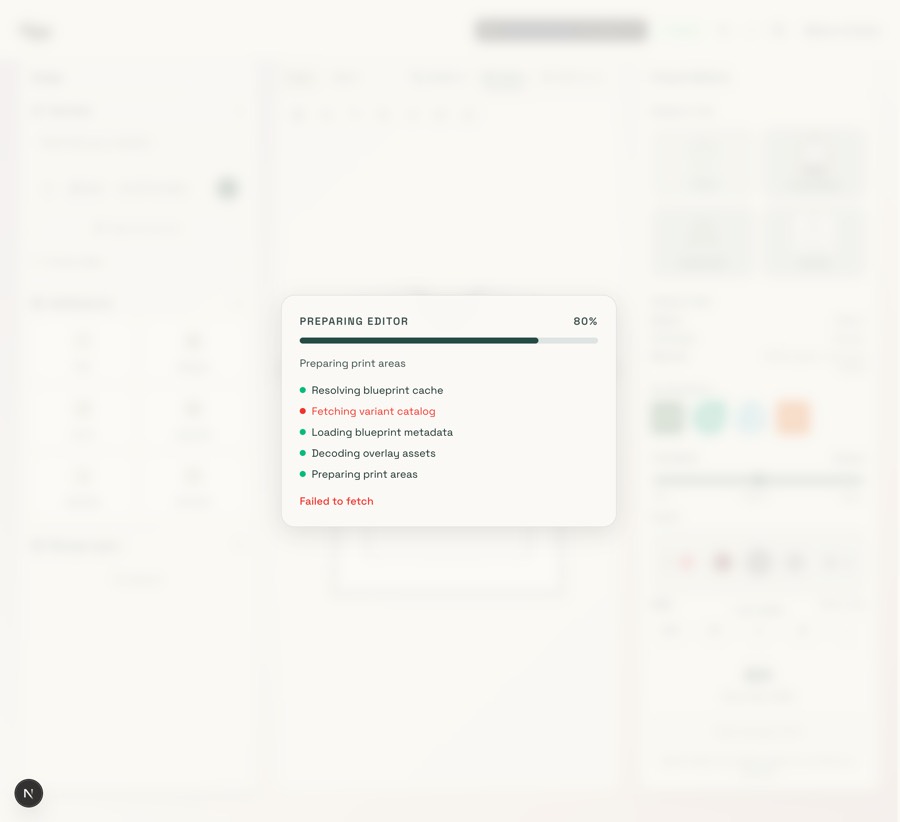
persistence adapter" decision. Also root-caused the editor boot hang:
worker-editor was missing its Printify API key (env drift — fixed, boot
passes now). /customize has a squeezed order-summary line + hardcoded
"tee" CTA; studio's hex input mangles 3-digit colors; /design's crop
inputs render garbled digits. Full defect tables live in
harness/evidence/openmerch-baseline/.
2026-07-05 · baseline QA running
Found your pnpm dev next-app had died (port 3000 is your
MedicalTextbook dev server); tilpas now runs on :3005
against the hosted dev Supabase. Provisioned QA fixture user
qa-openmerch@tilpas.test via admin API. Three parallel QA
agents are now exercising /customize, /tilpas/studio, and /design end to
end with screenshot evidence, while a fourth maps all editor code for
the SDK spec.
2026-07-05 · kickoff
Repo cleaned: recovered the uncommitted buyer-pack task, deploy hygiene,
and docs into three grouped commits on
codex/sota-garment-twin-plan, then branched
feat/openmerch-sdk. Code-map agent is sweeping all editor
code; baseline QA of the three surfaces starts now.
Screenshots